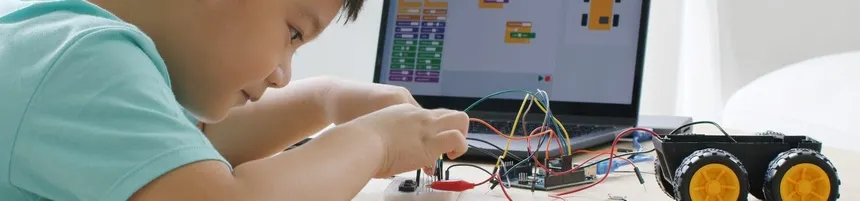
The first eight years of a child's life represent the most neurologically active window for learning. Research consistently shows that children who engage with STEM concepts early, not through rote memorization but through exploration, develop stronger problem-solving frameworks that carry forward through every stage of education.
But STEM education does not have to mean lesson plans and worksheets. Some of the most powerful early STEM experiences happen on kitchen tables, in backyards, and on the floor with a handful of building blocks. This post walks through why that matters and how to make it happen intentionally.
Why ages 0-8 are the critical STEM window. The science behind play-based learning. Simple at-home activities for every age. How to build a STEM mindset before kindergarten.
Why Early Childhood Is the Critical Window
Brain development research tells us that by age five, 90% of the brain's architecture is already in place. The neural connections formed during this period through sensory input, language, and cause-and-effect play become the scaffolding on which all future learning is built. STEM thinking, curiosity, hypothesis-testing, and pattern recognition are most naturally absorbed during this window.
This does not mean drilling a four-year-old on the periodic table. It means creating environments where asking why is celebrated, where experiments are allowed to fail, and where the process of figuring something out matters more than getting the right answer on the first try.
The Role of Play-Based STEM Learning
Play is not a break from learning. It is the mechanism through which young children learn. When a toddler stacks blocks and watches them fall, they are running physics experiments. The difference between incidental play and intentional STEM play is simply the presence of a curious adult who asks: what do you think would happen if?
- Water play with measuring cups - volume, estimation, and prediction
- Sorting objects by color, shape, or size - early data classification
- Building ramps with cardboard - gravity, friction, and engineering iteration
- Growing seeds in a cup - biology, observation journals, and patience
- Simple cooking tasks - measurement, chemical reactions, following a sequence
The goal of early STEM is not to produce scientists. It is to produce children who are not afraid of hard questions.
Building a STEM Mindset Before Kindergarten
A STEM mindset is really just a growth mindset applied to the physical world. It is the belief that problems are meant to be solved, that confusion is a starting point rather than a stopping point, and that every failed attempt carries data. These beliefs are not innate. They are modeled.
Apps like Scratch Jr. and Khan Academy Kids are genuinely useful, but they work best as a complement to hands-on physical exploration, not a replacement. Aim for a 3:1 ratio of tactile to screen-based STEM activities, especially under age six.
For homeschool families, this is one of the greatest advantages of the home environment. You are not bound by a 45-minute class period or a standardized test at the end of the week. You can follow a child's curiosity for three hours if the moment calls for it.
Where to Go From Here
The most important step is to start noticing the STEM already happening in your home. The next post in this series will walk through building a simple observation journal routine, a 10-minute daily habit that dramatically accelerates early scientific thinking.
If you found this post useful, the Resources directory has a curated list of curriculum tools, research databases, and professional development programs. All free or low-cost, all personally vetted.