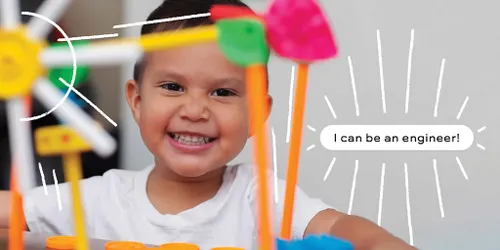
Did you know that your infant is forming roughly 700 new neural connections every second? That staggering rate of brain development makes the earliest years a once-in-a-lifetime window for building the cognitive foundations that underpin all of STEM — science, technology, engineering, and math. And according to a growing body of research, the most powerful place to start is not a classroom. It's your living room.
In her capstone paper STEM Begins at Home, STEM educator Renae Hernandez synthesizes findings from nine peer-reviewed and professional sources to make a compelling case: parents and caregivers are uniquely positioned to be a child's first — and most effective — science teachers.
The neuroscience is clear: the earlier you start, the stronger the foundation. And the best laboratory your child will ever have is already right under your roof.
Every Drop from the Highchair Is Data
When your baby hurls a spoon off the tray for the fifteenth time, they are not misbehaving — they are running a gravity experiment. When your toddler topples a block tower with glee, they are exploring momentum, structural integrity, and energy transfer. Hernandez argues that parents should recognize these moments for what they are — genuine scientific inquiry — and gently extend them by asking questions, inviting predictions, and varying the conditions.
A simple five-step loop adapted from the scientific method makes this accessible to any caregiver:
- Observe the child's interest and ask questions.
- Invite them to predict what will happen.
- Let them experiment.
- Talk about the results together.
- Redesign and try again.
Don't Spoil the Experiment
One of the hardest things for a knowledgeable adult to do is not give away the answer. But Hernandez stresses — backed by multiple studies — that supplying conclusions too early robs children of the very cognitive workout that makes STEM play so valuable. Creativity, imagination, problem-solving, literacy, social growth, and self-confidence all flourish when children are allowed to discover outcomes on their own terms.
Supplying conclusions too early robs children of the very cognitive workout that makes STEM play so valuable.
Mistakes Are the Point
Channeling Bob Ross's famous line — "There are no mistakes, only happy little accidents" — the paper argues that experimental failure is not a setback but a feature. Helping young children accept unexpected results, reflect on what went wrong, and redesign their approach cultivates grit and persistence that pay dividends far beyond the science fair.
You Don't Need Expensive Kits
Hernandez, a practicing high school physics teacher, shares how scrap wood from a maintenance closet and items from a recycling bin were enough to build a hands-on momentum lesson (and a modern-art "Veneer Moon" sculpture to boot). Yard-sale finds, kitchen utensils, cardboard boxes — these are all legitimate lab equipment for a toddler physicist.
Scrap wood, recycling-bin items, yard-sale finds, kitchen utensils, and cardboard boxes are all legitimate lab equipment for a toddler physicist. No expensive kits required.
Tap Your Community
Universities, museums, libraries, parks, nature centers, and local science clubs often offer free or nearly free STEM programming for families. Hernandez highlights examples like university makerspaces open to the public and astronomy clubs that host family star-viewing parties — resources that are widely available but frequently overlooked.
The Bottom Line
STEM education doesn't require AI tutors or high-tech gadgets. It requires attentive parents willing to follow a child's curiosity, ask good questions, and resist the urge to hand over the answers. The neuroscience is clear: the earlier you start, the stronger the foundation. And the best laboratory your child will ever have is already right under your roof.